The global lighting market is entering a more demanding phase. Energy prices, carbon targets, and stricter building standards are changing how buyers evaluate commercial luminaires. The International Energy Agency reports that lighting still represents a significant share of worldwide electricity use, despite rapid LED adoption. This makes the Led Panel Lamp more than a ceiling fixture. It is an energy, comfort, and maintenance decision.
This guide examines the 2026 panel lamp types most relevant to global buyers. It compares edge-lit, back-lit, suspended, surface-mounted, recessed, tunable-white, and smart-connected designs. Each type creates a different ceiling experience. An edge-lit panel can provide a slim profile, while a back-lit model may offer more uniform output and easier thermal management. The U.S. Department of Energy’s solid-state lighting research consistently highlights efficacy, optical control, color quality, and lifetime as essential performance factors. Yet published lifetime figures can be misunderstood. A rated 50,000 hours does not guarantee identical brightness in every hot, dusty, or poorly ventilated installation.
Professional buyers should review measured lumens, system efficacy, UGR, CRI, CCT stability, flicker performance, driver quality, and warranty terms. The DesignLights Consortium’s technical requirements also show why verified testing matters, rather than relying only on attractive product claims. Local voltage, emergency-lighting rules, fire requirements, and conformity marks must be checked for each destination market. No single panel wins everywhere. A bright office panel may feel uncomfortable in a classroom or hotel corridor. This overview therefore focuses on practical trade-offs, credible data, and the small installation details that often decide long-term value.
For global buyers, LED panel lamps are often compared by three basic figures: efficacy, color temperature, and color rendering. Typical performance reaches 100–150 lm/W under stated laboratory conditions. In a real ceiling, heat, diffuser loss, and driver efficiency may reduce that result. Check the complete fixture output, not only the LED chip rating.
Color temperature usually ranges from 3000K to 6500K. Warm 3000K light feels comfortable in hotels, restaurants, and residential rooms. Neutral 4000K suits offices and classrooms. Cooler 5000–6500K can support a sharper appearance in workshops or healthcare areas, but it may feel harsh in relaxed spaces. CRI should generally be 80 or higher. For retail, art, or inspection work, higher CRI can reveal fabric, skin, and product colors more accurately.
A practical specification should show testing conditions, lifetime data, lumen maintenance, and driver details. Ask whether the quoted 120 lm/W includes the diffuser and power supply. That small question prevents expensive surprises. Review glare control too, especially under large computer screens. UGR data can help, though it is not always measured consistently. Some choices still require judgment. A cooler lamp may improve visibility, yet occupants may dislike it after long hours. Measure twice. Then test a sample room before ordering thousands of units.
Choosing the right LED panel lamp in 2026 depends on more than wattage. Edge-lit panels use LEDs around the frame and a light guide to spread illumination. They are slim and lightweight, which suits low ceilings and tight installations. However, poor optical design can create bright edges or darker centers. I have seen this during warehouse inspections.
Back-lit panels place LEDs behind the diffuser, creating a wider light distribution. They usually offer better uniformity than basic edge-lit models. Direct-lit panels also use rear LEDs, but their light sources sit closer to the diffuser and often use lenses or reflective cavities. This design can improve optical efficiency and reduce light loss. It may also require more installation depth.
For commercial buyers, compare measured efficacy, not marketing claims alone. A useful target is 100–140 lumens per watt, depending on optics and driver quality. Check the Unified Glare Rating, color consistency, and illumination at desk height. Ask for photometric files and test samples under real ceiling conditions. A panel may look uniform on a showroom wall but show visible grid patterns after installation. That detail is easy to miss. Energy savings also depend on controls, operating hours, and maintenance access. Edge-lit products can win on form factor, while back-lit or direct-lit designs often provide steadier brightness across larger rooms. Neither choice is perfect.
| Evaluation Dimension | Edge-Lit LED Panel | Back-Lit LED Panel | Direct-Lit LED Panel | Buyer Guidance for 2026 |
|---|---|---|---|---|
| Light-emitting arrangement | LEDs are positioned around the panel perimeter and inject light into a light-guide plate. | LEDs are arranged behind the diffuser, generally in a regular grid. | LEDs are mounted directly behind the diffuser or optical plate, typically with a deeper housing. | Confirm the optical layout, LED spacing, diffuser structure, and housing depth rather than relying only on the product name. |
| Typical fixture thickness | Approximately 8–15 mm for many slim recessed or surface-mounted designs. | Approximately 25–40 mm, depending on LED pitch and optical cavity depth. | Approximately 30–60 mm, although some low-profile designs are thinner. | Choose edge-lit for shallow ceiling voids; verify actual cut-out, driver, and heat-sink clearances before installation. |
| System efficacy | Typically about 90–125 lm/W at fixture level, depending on diffuser, driver, and light-guide losses. | Typically about 100–140 lm/W at fixture level when the optical cavity and diffuser are well designed. | Typically about 95–135 lm/W at fixture level, with fewer light-guide losses but possible cavity and diffuser losses. | Compare tested fixture lumens divided by input watts. Do not compare LED chip efficacy with complete-fixture efficacy. |
| Uniformity | Commonly 80–90% minimum-to-average uniformity when the light guide and diffuser are properly engineered. | Commonly 85–95% minimum-to-average uniformity because the LEDs are distributed across the rear surface. | Commonly 80–95% minimum-to-average uniformity; results depend strongly on LED pitch and diffuser distance. | For offices, classrooms, and healthcare areas, request photometric files and a uniformity calculation for the complete space. |
| Visible hot spots or dark zones | Low when the light guide is high quality; edge brightness and corner variation can appear in lower-cost designs. | Generally low because the LED array is distributed behind the diffuser; inadequate spacing can still cause point visibility. | Low to moderate depending on LED pitch, diffuser transmission, and cavity depth. | Inspect an illuminated sample at normal viewing distance and at oblique angles before approving a large order. |
| Glare control | Can provide low glare with a micro-prismatic or high-quality opal diffuser; optical performance varies by diffuser. | Usually supports good glare control because the deeper cavity spreads luminance before it reaches the diffuser. | Can achieve good glare control, but shallow cavities and high-output LEDs may increase luminance contrast. | Request UGR data calculated for the intended room geometry; UGR is not a fixed property of the panel alone. |
| Thermal management | Usually requires effective heat spreading through the frame and rear plate because the LED sources are concentrated near the edges. | Generally offers balanced heat distribution across the rear panel and a larger area for passive cooling. | Often provides good heat distribution, but thermal performance depends on PCB, housing material, and ventilation. | Check measured operating temperature, driver temperature, and rated ambient temperature for enclosed ceilings. |
| Light distribution | Often wide and diffuse, commonly suitable for general ambient lighting. | Typically wide and consistent, with good control through diffuser and optical film selection. | Wide distribution is common, but beam shape can vary more with LED spacing and reflector design. | Use the IES or LM-63 photometric file to confirm spacing criteria and maintained illuminance. |
| Dimming and controls | Compatible with common 0–10 V, DALI, phase-cut, or wireless controls when the correct driver is specified. | Broad control compatibility is available, subject to driver selection and regional electrical requirements. | Broad control compatibility is available; verify low-end dimming, flicker, and inrush-current performance. | Specify the control protocol, dimming range, flicker limits, and emergency-lighting interface before purchase. |
| Color quality | Commonly available in 80+ or 90+ CRI, with typical CCT options from 2700 K to 6500 K. | Commonly available in 80+ or 90+ CRI and standard CCT ranges from approximately 2700 K to 6500 K. | Commonly available in 80+ or 90+ CRI; tunable-white and color-consistency options depend on the LED package. | Require binning information, color-consistency data, and test reports for projects with strict visual-quality requirements. |
| Estimated service life | Quality products are often rated around 50,000–100,000 hours to L70, subject to temperature and driver conditions. | Quality products are often rated around 50,000–100,000 hours to L70, with thermal design strongly affecting actual life. | Quality products are often rated around 50,000–100,000 hours to L70; the driver may have a shorter rated life. | Check L70, driver lifetime, warranty terms, ambient-temperature limits, and lumen-maintenance test conditions separately. |
| Maintenance and repair | Thin and lightweight, but light-guide or edge-LED repairs may be less convenient than modular rear access. | Usually easier to service from the rear when the panel uses replaceable drivers or modular LED boards. | Often practical to service when the LED board and driver are replaceable; construction varies by model. | For high-installation-cost sites, prioritize replaceable drivers, accessible connectors, and documented spare parts. |
| Relative first cost | Often medium to high because the light-guide plate and optical films add material and manufacturing cost. | Often medium; the design can balance optical performance, material use, and manufacturing complexity. | Often low to medium, although premium diffusers, controls, and high-efficiency components increase cost. | Compare total installed cost and energy cost rather than purchase price alone. |
| Best-fit applications | Low-clearance offices, retail interiors, hospitality spaces, corridors, and retrofit projects requiring a slim appearance. | Offices, schools, healthcare, commercial buildings, and projects prioritizing strong uniformity and low glare. | Large-scale commercial projects, cost-sensitive installations, warehouses, utility areas, and general-purpose interiors. | Select based on ceiling depth, visual comfort, maintenance access, target illuminance, and lifecycle cost. |
| Overall 2026 selection priority | Best when ultra-slim installation and appearance are more important than maximum efficacy. | Best all-round option when uniformity, glare control, efficiency, and serviceability must be balanced. | Best when competitive efficiency, consistent output, and scalable procurement are the main priorities. | For final approval, compare independently tested lumens, watts, UGR, uniformity, flicker, lifetime, and warranty conditions. |
Note: Performance ranges are typical market benchmarks for complete LED fixtures, not guaranteed values. Actual results vary with LED package, driver, diffuser, optical design, operating temperature, installation method, and testing standard.
2026 Best LED Panel Lamp Types for Global Buyers?
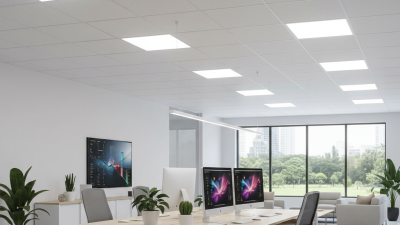
For offices and schools, 600×600 mm LED panels remain practical replacements for recessed ceiling grids. Choose wattage by room use, ceiling height, and target illuminance. Common options range from 30W to 40W, while larger spaces may need 50W units. A 120° beam spreads light evenly across desks and walkways. It can reduce dark patches, but only when panels are spaced correctly.
UGR <19 is important for computer rooms, meeting areas, and classrooms. However, the panel alone cannot guarantee low glare. Ceiling finish, screen position, wall color, and mounting height also affect visual comfort. Ask suppliers for photometric files, UGR test conditions, lumen output, color consistency, and driver specifications. In practical checks, I have found that advertised glare values may change after installation. This deserves careful review.
Tips: Compare real layouts before ordering. Mark a 600×600 mm ceiling grid on the plan. Test one panel beside a monitor. Check flicker, shadows, and uncomfortable reflections. Select the lowest suitable wattage, not simply the brightest model. For global purchasing, confirm voltage range, emergency compatibility, packaging strength, and installation instructions. A 120° beam may look efficient on paper, yet a poorly designed layout can still leave corners dim.
Typical 600×600 mm LED panel specifications for 120° beam applications with UGR <19.
Edge-lit and back-lit panels commonly deliver balanced efficiency at approximately 36–40 W. Direct-lit models can provide higher uniformity with comparable power, while tunable-white panels typically use more power because of additional LED channels and control electronics. The values shown are representative non-brand market specifications; actual performance varies by optical design, driver, diffuser, and certification requirements.
For global buyers, a 50,000-hour claim is only useful when its test basis is visible. Whether comparing edge-lit or back-lit panels, request model-specific evidence. LM-80 evaluates LED package or module lumen maintenance, not the complete panel lamp. It records light output, color shift, drive current, temperature, and testing duration. Ask for the full report, not a cropped certificate. A neat number can still mislead. The operating temperature matters.
TM-21 uses LM-80 data to project lumen maintenance over time. That projection depends on case temperature, drive current, sample size, and extrapolation limits. A credible supplier should show the selected data set and explain the L70 calculation. L70 means the point when output reaches 70 percent of initial lumens. It does not mean the lamp suddenly fails. This distinction is often missed.
For a 100,000-hour target, compare projected life with the actual panel design. Check thermal paths, driver reliability, diffuser aging, ambient temperature, and cleaning conditions. The LEDs may last, while another component weakens earlier. Request photometric data from an independent laboratory when the application is critical. Keep the installation record, including mounting position and measured temperature. I would still question any claim without model-specific evidence. Evidence should be repeatable, current, and tied to the purchased configuration. That is less exciting than a large life number. It is far more useful.
2026 Best LED Panel Lamp Types for Global Buyers?
Global buyers should match the panel design with the installation environment. Edge-lit panels provide slim profiles and smooth light distribution. Back-lit panels often allow stronger heat management and simpler internal layouts. Selectable color temperature models can suit offices, classrooms, and retail spaces, but controls must be checked carefully.
CE marking shows that the product meets applicable European conformity requirements. It is not a universal quality certificate. RoHS documentation should identify restricted substances and cover the exact product model. Ask for current test reports, declarations, and technical files, not only printed logos. Small details matter.
UL/ETL listing is commonly requested for North American projects, while DLC eligibility may support energy-efficiency programs. Requirements can change by product category and revision. Confirm the model number, efficacy, wattage, and dimming options. A 100–277V input supports many commercial electrical systems, but frequency, grounding, driver compatibility, and surge protection still require review. Do not assume wide voltage means universal compatibility.
I once treated certificates as the final buying decision. That was too simple. Installation photos, sample testing, flicker data, and warranty terms reveal practical weaknesses. Check the panel at low voltage and full load. Some documents look complete, yet the listed driver differs from the shipped unit.