2026 Top Circuit Breaker Types for Global Buyers?
Choosing the right Circuit Breaker in 2026 requires more than comparing prices and interrupting ratings. Global buyers now evaluate safety, reliability, installation conditions, certification, and long-term maintenance. A compact MCB may suit a residential distribution board, while an MCCB can protect larger commercial loads. ACBs remain important for main low-voltage switchboards, and RCBOs add overcurrent and residual-current protection in one device. Medium-voltage projects may require vacuum circuit breakers, especially where frequent switching and dependable arc control matter.
Real purchasing decisions often begin with the site, not the catalogue. Engineers examine voltage, fault current, ambient temperature, enclosure space, cable size, load type, and expected service life. A breaker installed in a dusty factory faces different demands from one used in a clean office building. Buyers should review datasheets, type-test evidence, quality records, warranty terms, and manufacturer traceability. Independent laboratory reports can strengthen confidence, but documents still need careful verification.
There is no universal “best” type.
International projects may reference IEC, UL, or other recognized standards, depending on the destination and system design. Certification alone does not guarantee suitable performance in every application. That point is easy to overlook. Experienced procurement teams compare genuine operating data rather than relying on attractive marketing claims. They also confirm replacement availability and technical support before signing a purchase order. This guide examines the top Circuit Breaker types for global buyers in 2026, while acknowledging one uncomfortable truth: product selection can remain uncertain when site data is incomplete or supplier information is inconsistent.
Circuit Breaker Fundamentals: IEC 60947-2, UL 489, and Core Ratings
For global buyers, circuit breaker selection starts with the application, not the product label. IEC 60947-2 covers low-voltage circuit breakers used in industrial and commercial distribution systems. UL 489 addresses molded-case circuit breakers, molded-case switches, and related protection equipment. These standards test performance differently, so approval under one standard does not automatically confirm compliance with the other.
Core ratings require careful reading. Rated voltage must match the system, while rated current should reflect continuous load and enclosure temperature. Short-circuit capacity is equally important. Under IEC practice, Icu indicates ultimate breaking capacity, while Ics indicates service breaking capacity. A breaker may interrupt a fault once, yet provide limited service performance afterward. That detail is easy to miss. Under UL 489, interrupting ratings, temperature performance, dielectric strength, and endurance are key evaluation areas.
Practical selection also involves poles, frequency, trip curves, ambient conditions, and coordination with upstream protection. A 100 A rating alone says very little. Check the available fault current at the installation point. Then verify whether the breaker’s interrupting rating exceeds it. Selective coordination can reduce unnecessary shutdowns, but it may require slower upstream protection. The cleanest datasheet is not always the safest choice. Installation conditions deserve a second review.
MCBs: IEC 60898-1, 6–63 A, and B, C, D Tripping Curves
For global buyers, MCBs rated from 6 to 63 A remain a practical choice for residential and light-commercial distribution boards. IEC 60898-1 defines requirements for circuit breakers protecting alternating-current installations. It also supports clear selection through B, C, and D tripping curves. Compact protection matters.
A B-curve MCB trips magnetically at about 3–5 times its rated current. It suits lighting circuits, sockets, and resistive loads with limited startup current. A C-curve operates around 5–10 times rated current. This makes it more suitable for small motors, pumps, compressors, and mixed commercial circuits. A D-curve responds at roughly 10–20 times rated current. It is intended for equipment with heavy inrush, but the installation must provide sufficient prospective short-circuit current.
The IEA Electricity 2024 report forecasts global electricity demand growth of about 3.4% annually from 2024 to 2026. More cooling, automation, and distributed equipment will increase low-voltage protection requirements. Buyers should check rated voltage, breaking capacity, pole configuration, ambient temperature, and conductor size, not only amperage. Field inspections often find oversized breakers protecting undersized cables. That error is simple, yet dangerous. Curve selection also deserves review. A C-curve is not automatically better than a B-curve, and a D-curve may fail to disconnect quickly where fault current is weak. Reference: IEC 60898-1 and IEA Electricity 2024.
2026 Top Circuit Breaker Types for Global Buyers? - MCBs: IEC 60898-1, 6–63 A, and B, C, D Tripping Curves
| MCB Type / Curve |
Applicable Standard |
Common Rated Current (In) |
Instantaneous Magnetic Trip Range |
Typical Circuit Use |
Selection Considerations |
| B Curve MCB |
IEC 60898-1 |
6, 10, 13, 16, 20, 25, 32, 40, 50, 63 A |
3–5 × In |
Lighting circuits, socket outlets, and low-inrush residential loads |
Provides the most sensitive magnetic response of the three common curves; confirm that normal starting current will not cause nuisance tripping. |
| C Curve MCB |
IEC 60898-1 |
6, 10, 13, 16, 20, 25, 32, 40, 50, 63 A |
5–10 × In |
General-purpose commercial circuits, small motors, pumps, fans, and moderate-inrush equipment |
A widely used compromise between overload protection and tolerance of starting current; verify loop impedance and prospective fault current. |
| D Curve MCB |
IEC 60898-1 |
6, 10, 13, 16, 20, 25, 32, 40, 50, 63 A |
10–20 × In |
Transformers, high-inrush motors, compressors, welding equipment, and inductive loads |
Requires careful fault-loop and short-circuit verification because the magnetic trip threshold is higher. |
IEC 60898-1 MCB Reference Data for Global Buyers
| Data Dimension |
Reference Value |
Buyer Relevance |
| Product category |
Miniature circuit breaker (MCB) |
Designed for overcurrent and short-circuit protection in final and distribution circuits. |
| Primary product standard |
IEC 60898-1 for circuit-breakers for household and similar installations |
Check the exact edition, national adoption, certification, and marking requirements for the destination market. |
| Common current range covered in this comparison |
6–63 A |
Select In according to conductor ampacity, installation method, ambient conditions, and expected load current. |
| Common standard current values |
6, 10, 13, 16, 20, 25, 32, 40, 50, and 63 A |
Availability may vary by market and pole configuration; verify the product datasheet before ordering. |
| Typical operating voltage |
230/400 V AC systems are common; IEC 60898-1 covers applicable AC devices within their marked ratings |
The device voltage marking must be compatible with the system voltage and earthing arrangement. |
| Common rated short-circuit capacities |
3, 4.5, 6, and 10 kA are commonly specified market values |
Choose a rated short-circuit capacity not lower than the prospective short-circuit current at the installation point. |
| Overload reference behavior |
Thermal trip behavior is time-dependent and governed by the standard test conditions and declared rating |
Do not use the instantaneous curve alone to determine cable protection or allowable continuous load. |
| Typical pole configurations |
1P, 1P+N, 2P, 3P, and 4P configurations are commonly available |
Pole selection depends on the supply arrangement, neutral switching requirements, and local installation rules. |
| Typical frequency |
50/60 Hz systems, subject to the product marking |
Confirm frequency compatibility for the destination country and application. |
| Installation mounting |
DIN-rail mounting is widely used in distribution boards |
Check rail compatibility, terminal capacity, enclosure dimensions, and required accessories. |
Technical note: The B, C, and D ranges are instantaneous magnetic trip bands expressed as multiples of the rated current. Final selection must also consider cable size, installation method, ambient temperature, voltage, prospective fault current, discrimination, and the electrical rules applicable in the destination market.
MCCBs and ACBs: 16–6,300 A Protection for Industrial Networks
For global industrial buyers, MCCBs and ACBs cover a practical protection range from 16 to 6,300 A. MCCBs commonly protect outgoing feeders, motors, and compact distribution boards. ACBs serve high-current incomers, bus couplers, and generator connections. The boundary is not absolute.
IEC 60947-2 requires buyers to examine rated short-circuit breaking capacity, service breaking capacity, and trip performance. A 400 A frame may not provide 400 A continuously under every ambient condition. Cable grouping, enclosure temperature, altitude, and ventilation can reduce usable capacity. Small details matter. The IEA’s Electricity 2024 report forecasts average global electricity-demand growth of about 4% annually from 2024 to 2026. More load means greater pressure on selectivity and thermal margins.
A credible specification should match the breaker to the fault level at its installation point. MCCBs with adjustable electronic trips can improve coordination across long feeder chains. ACBs usually offer deeper settings, zone-selective interlocking, and easier maintenance access in main switchboards. The Energy Institute’s Statistical Review of World Energy 2024 recorded global electricity generation above 29,000 TWh in 2023, showing the scale of networks requiring dependable interruption. Yet a higher ampere rating is not automatically safer. I have seen neat rating schedules fail when engineers ignored inrush current and prospective fault calculations. That is worth reconsidering. Reliable procurement combines IEC compliance, verified test data, local grid conditions, and documented coordination studies.
RCCBs and RCBOs: IEC 61008/61009 and 30 mA Residual Protection
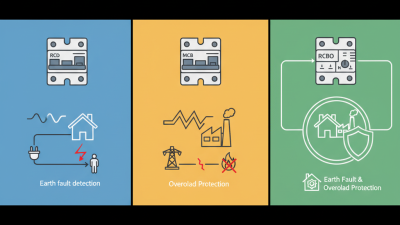
For global buyers, RCCBs and RCBOs remain central to low-voltage safety planning. IEC 61008 covers RCCBs, while IEC 61009 covers RCBOs. An RCCB detects residual current but does not protect against overloads or short circuits. An RCBO combines residual-current protection with overcurrent protection in one device. That difference affects panel space, coordination, and replacement costs.
The 30 mA setting is widely used for additional protection against electric shock. It is not a magic shield. The UK Health and Safety Executive notes that a 30 mA RCD can disconnect rapidly and substantially reduce fatal shock risk. However, protection depends on correct earthing, wiring, testing, and realistic trip coordination. A neat specification can still fail in a damp workshop. NFPA research reported that electrical distribution and lighting equipment was involved in about 24% of U.S. home structure fires from 2015 to 2019. The figure is not a direct RCCB failure rate, but it shows why selection deserves engineering attention.
Buyers should verify rated voltage, current, residual operating current, pole configuration, breaking capacity, and trip characteristics. Type A devices can detect pulsating DC residual currents from modern electronic loads. Type AC may be unsuitable for some appliances, even when the label looks acceptable. Installation conditions matter. So does maintenance. I would request IEC test documentation, independent laboratory evidence, and clear operating instructions before approving a shipment. Certification alone is not enough when product markings, local networks, and installation practices differ.
Vacuum Circuit Breakers: IEC 62271-100 for Medium-Voltage Systems
2026 Top Circuit Breaker Types for Global Buyers?
Vacuum Circuit Breakers: IEC 62271-100 for Medium-Voltage Systems
Vacuum circuit breakers remain a strong choice for medium-voltage distribution, especially from 1 kV to 52 kV. IEC 62271-100 defines key requirements for AC circuit-breakers, including rated voltage, short-circuit interruption, operating sequences, and type testing. The IEA’s Electricity 2024 report forecasts global electricity demand will grow by about 3.2% annually through 2026. More switching points will require dependable protection. In field projects, buyers should check the vacuum interrupter’s rated short-circuit current, mechanical endurance, insulation level, and switching duty. A compact panel is useful. It is not everything.
Tips: Request complete IEC test documentation, not only a compliance statement. Confirm altitude, ambient temperature, humidity, and seismic requirements before approval. Check the control voltage and trip-coil performance under low-voltage conditions. Maintenance is usually limited, but contact wear and operating mechanisms still need inspection. The IEC 62271-100 framework improves comparison, yet local grid rules may add different testing or installation demands.
A common mistake is choosing only by purchase price. Installation space, protection coordination, spare parts, and service access can change the lifetime cost. I would also question unusually long endurance claims without supporting test reports. No checklist is perfect. Real operating data should influence the final selection.